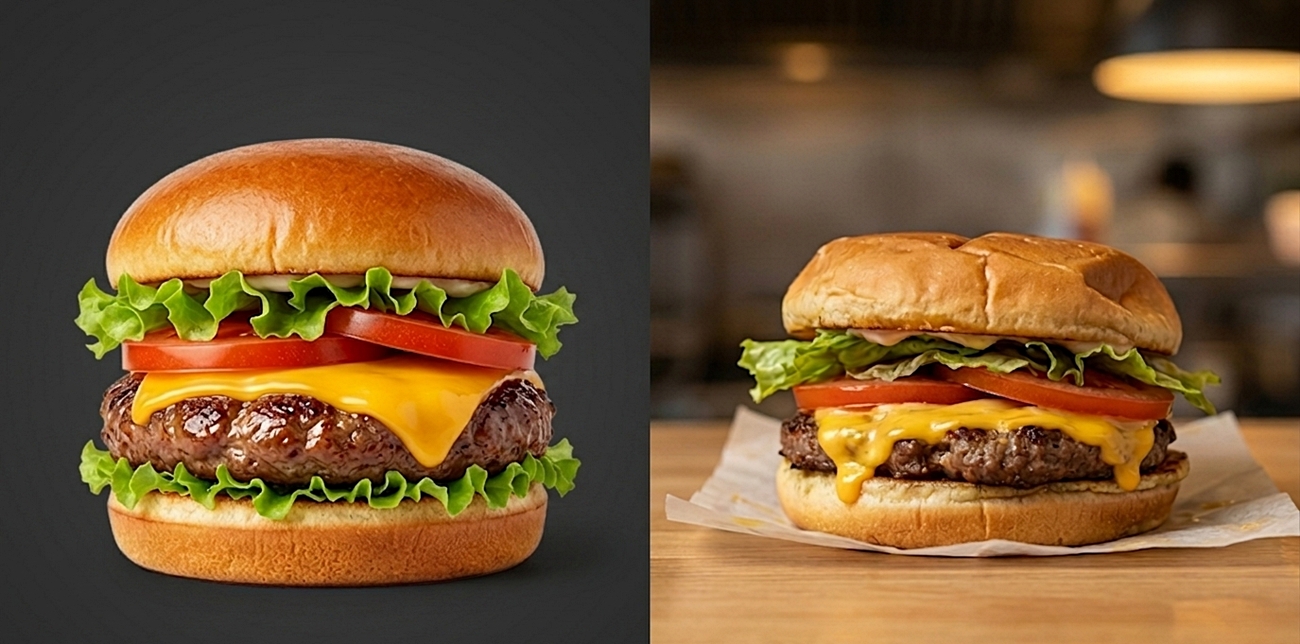
If I had a Rupee for every time I heard this question during my years in leadership roles at McDonald’s, I’d probably be a millionaire. Those who have been in a similar space. It is the age-old customer grievance: You see an aesthetic, burger or something similar like a pizza, taco or even a biryani bowl, on the glowing digital menu board. It looks like a culinary marvel. You order it, wait, and much to your dismay, find a version that looks like it has been through a gravitational collapse. And it goes without saying that as a customer, you feel cheated. You feel like you’ve been “catfished” by your food. But as someone who has lived behind that counter, I can tell you that the gap between the photo and the plate isn’t definitely a scam, it’s a masterclass in the clash between advertising art and operational speed. Or simply put its nothing but a classic case of “The Science of Expectations vs. The Reality of Operations”
The “Hero” Dish: The Art of Food Styling!
The purpose behind it simple. Before looking at the kitchen, one must look at the photo. The item seen on a digital board is known in the industry as a “Hero.” Food stylists and photographers spend hours, sometimes even days, to get that perfect snap of the plate. and to ensure this, they use methods that are not practically possible or recommended in a live kitchen. Yes, we repeat their job is to make the food visually appealing, not safe to consume. And to make the food “photogenic”, they use techniques that are physically impossible in a kitchen.
Ok, let’s take a Burger on the digital board behind the counter and find the story behind that perfect snap.
- The Tilt: To show every ingredient (lettuce, tomato, sauce, protein), stylists push everything toward the front. In reality, these items are stacked vertically for structural balance. In a photo, they are on a slope to show off the “assets.”
- Structural Support: Stylists often use toothpicks, hidden sponges, or even cardboard spacers to give a dish height and stability that gravity would normally take away.
- The Perfect Melt: To get that ideal “amber drape” of cheese, stylists don’t use heat lamps. They often use handheld garment steamers or hairdryers to melt only the visible edges, keeping the centre firm so it doesn’t slide off.
- Chemical Glisten: To make proteins look succulent, they are often brushed with vegetable oil or kitchen bouquet. This provides a permanent “fresh out of the pan” shine that doesn’t dry out under hot studio lights.
We suggest you watch the video below from Business Insider to learn more about the whole process of making the food “camera-ready”
The Operational Physics of the Kitchen
In a high-volume, busy restaurant, the enemy isn’t the camera; it’s entropy and time. The word “Entropy” may seem fancy, simply put, it’s the natural “decline into disorder” that happens to food the second it leaves the hands of a chef, a crew member or a Barista. All Professional kitchens are governed by SOPs (Standard Operating Procedures) designed for speed, Accuracy, safety, and temperature.
- The Steam Trap: You walk into a restaurant and order a burger or any item that is usually served hot, and the burger is made and wrapped right in front of your eyes by the crew member. The heat there creates steam that helps to keep the burger warm. But it also softens the bun and makes the vegetables and green leaves wilt.
- The Physics of Packaging: A “Hero” dish on the digital screen is made inside a studio and is held together by pins. On the other hand, a real dish is held together by its wrapper or the box. As it sits in a heated holding area, gravity naturally causes the ingredients to settle and “flatten.”
- The Time Constraint: It is to be noted that a stylist at a studio has the luxury of time, anything around half a day, whereas the Kitchen staff does everything from toasting to assembling to packing in around a minute, especially during the busy hours.
The Digital Board Dilemma isn’t specific to burgers
This particular issue isn’t exclusive to fast food outlets. In 2026, almost every dining space, be it a cafe or a premium salad bar, has digital menu boards. That shows your “superfood bowl” with each grain of quinoa shining. The latte art on the coffee appears to be etched by a professional. Simply put, the purpose of a digital menu board is to trigger an appetite response. And they use light and contrast to make colours pop, ensuring nothing short of a ” Perfect Picture”. which can never be replicated by physical ingredients inside the kitchen.
The Global Consistency Challenge
For global brands, the challenge isn’t just making the food look like the photo; it’s making it taste the same. be it Bangalore or Berlin. Every element, from the toast level of a bun to the exact millilitre of sauce dispensed, is calibrated the same to achieve this. If a kitchen spent 10 minutes making a dish look exactly like the one on the digital screen, make no mistake, it would be cold by the time it reached the customer. In operations, Temperature and Taste always beat Aesthetics.
Technology to the rescue
The industry is changing slowly but steadily. Customers have started demanding “authentic” photography, and new technology is helping kitchens achieve better visual results.
- Visual QC (Quality Control): High-end establishments are now testing AI-powered cameras over the assembly line. If a build is lopsided or the proportions are off, the system flags it before the food is served.
- Vented Packaging: Advanced packaging methods now allow steam to escape without the food losing heat, helping maintain the “loft” and texture seen in advertisements.
An Insider’s Advice: How to Judge Your Meal
The next time a meal doesn’t perfectly mirror the glowing image on the wall, look for the three indicators of a truly well-run operation:
- Temperature: Is the food steaming and looks fresh to your eyes? This is the primary metric of safety.
- Build Order: Are the ingredients done in the correct sequence? A correct build ensures the intended flavour profile.
- Freshness: Softer buns and melted cheese, you are good to go.
