
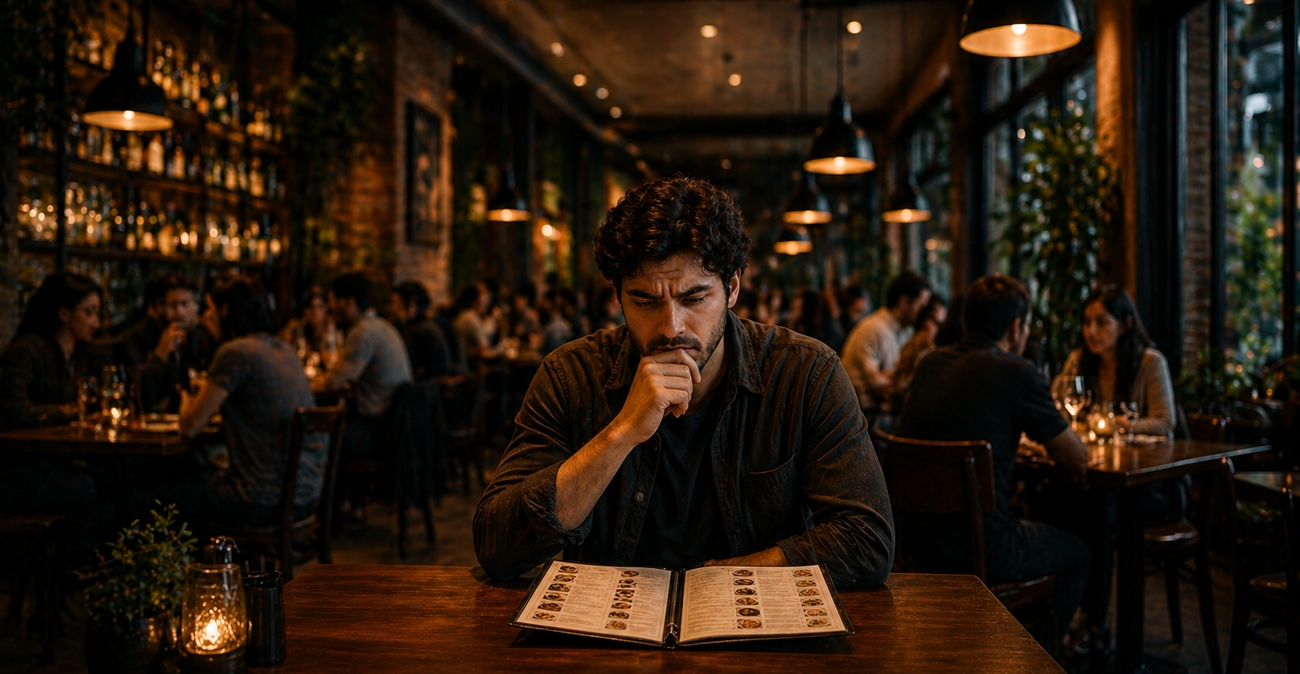
Yes, we’ve all been there. right? sitting down at a restaurant, opening the menu card, and instead of feeling excited, you feel… overwhelmed. just because of the options provided, categories within categories, dishes you’ve never heard of, and combinations that sound impressive but confusing for many. What should be a simple decision suddenly becomes a struggle. But then there are some who love exploring the unexplored. Relishing the luxury of tasting something that they’ve only heard of. More choices are supposed to make things better, to provide a better dining experience. And this is what the general perception is, because with more variety means more freedom for customers, and a higher chance of finding something you’ll enjoy. But in reality, for most people, the opposite often happens. More choices don’t make decisions any easier for them: they make them harder. And in many cases, they lead to worse dining experiences. This blog is digging deep into this.
The Illusion of Variety
A customer enters the restaurant and opens the menu. A large menu, for sure, feels like a positive sign. It suggests that the restaurant has something for everyone. For those wanting comfort food, or those looking for something experimental, or even a safe classic dish, all covered.
But this abundance can create the illusion!!!
Think of it this way: When too many options are presented, instead of creating freedom, they can destroy or dilute clarity. Instead of helping customers decide, they force them to evaluate and compare and second-guess.
The variety turns into clutter for them, ruining their confidence.
Think of a real-life scenario, you are at a restaurant, which has a 10-12 page menu offering everything from North & South Indian to Chinese, Italian and even Burgers. You start scanning, but could confirm anything. Starts from the beginning. Then quickly jump to another section. After a few minutes, instead of feeling excited, you feel stuck. Not able to make a decision, what to order, your all-time favourite or a new one on the menu. This confusion eventually forces you to try a dish you’ve had many times before. not because you desired it, but it was the easiest decision. Restaurants are not doing it on purpose, but that’s how life treats us some days. right?
Decision Fatigue at the Table
Before talking about this, we must realise that Human decision-making has limits. Every choice we make throughout the day, starting from what to eat, wear or where to go, requires your mental energy. By the time someone sits down at a restaurant, that energy is partially gone. A long, complex menu can only make things worse. Instead of making a quick, satisfying choice, customers find themselves:
- Scanning pages repeatedly
- Comparing similar dishes
- Trying to understand unfamiliar descriptions of unknown dishes
- Worrying about making the “wrong” decision
This is known as decision fatigue.
And when it sets in, people don’t necessarily choose what they want. They choose what feels easiest. Sometimes that means ordering the most familiar item. Other times, it means picking something at random just to end the process. Either way, the decision is no longer intentional but somewhat recreational.
The Fear of Regret
More choices do not mean to create difficulty. But, for many, it can create doubt. When a menu offers dozens of appealing options, every decision comes with an underlying question. “What if something else would’ve been better?” This is where regret enters the experience. This also means even before the food arrives, customers begin to question their choice. They notice what others are ordering and reconsider options they skipped, even mentally comparing what they selected with what they didn’t.
The feeling of “I should have ordered that instead” lingers even after they leave.
Make no mistake, this feeling comes not because the restaurant lacks quality, but they offer excess of options. Sounds strange, right? But that’s the reality sometimes.
When Everything Is Offered, What Stands Out?
There’s another subtle effect of large menus: they reduce perceived expertise. After seeing a large menu, with Pizza, Pasta, Burger, Kababs or even Sushi, it’s very likely that a customer thinks, can they really be good at this? For those, Specialisation builds trust. It signals focus, skill, and confidence. On the other hand, an overly broad menu can do the opposite. It can make the restaurant feel scattered, and the customers think as though it’s trying to appeal to everyone rather than excel at something specific. No, not all customers think this way, but they feel it for sure. And this very thought can ruin the entire dining experience for them.
The Power of a Curated Menu
Smaller, well-curated menus often create a better experience. Especially in this context, but in a larger sense, we always believe it’s great when a restaurant can offer a wider menu and deliver it in the right way. Coming back to the topic, the better experience is not because they offer less, but because they offer clarity to those who are in doubt. In other words, a smaller menu tells the customer,
- This is what we do best
- These are the dishes we stand behind
- You don’t need to overthink this
It removes pressure from the customer. Instead of choosing from endless possibilities, a small, focused menu can guide an unsure customer to a set of confident options. This doesn’t limit choice, but it improves it. Especially when their aim is to make better decisions, not to have more options.
How Menu Design Influences Choice
Menus are not neutral. They are designed to guide customer behaviour. Restaurants often highlight certain dishes, use specific placements, create categries in a way that influences customer decisions. But when a menu becomes too large, even these design elements lose effectiveness. And customers miss the structure. They skim the menu instead of reading it. They guess instead of deciding. Restaurants always want the menu to guide their customers, in such situations, that very idea breaks down totally.
Simply put, A well-designed menu works because it simplifies things. An overloaded one does the opposite.
The Comfort of the “Safe Choice”
This goes without saying: when faced with too many options, customers tend to fall back on familiarity. They order:
- The dish they’ve had before
- The most recognisable item on the menu.
- The “safe” option that carries the least risk.
This is not because customers lack curiosity; it’s because they want certainty. Ironically, a large menu that promises variety and exploration often leads customers to repetitive choices, so customers stick to what they know. Not because they want to, but the environment drags them there.
Speed vs Experience
We always believe dining is not just about the food, it’s about the overall experience, and for some, a long menu ruins the experience because it takes them more time to decide. which can lead to:
- Longer ordering time
- Delayed service
- Reduced enjoyment in the moment
What should feel smooth and effortless becomes slightly stressful and dragged. On the other hand, a clear and focused menu speeds things up. Decisions are quicker, service feels more efficient, and the experience becomes more enjoyable. This simplicity enhances flow, and flow is what makes dining feel seamless.
The Gap Between Expectation and Satisfaction
This particular part is the actual paradox of the entire topic. And much more important than one might think. Customers are likely to expect more choices because it pleases them. However, too many choices don’t help at all: in fact, it ruins their experience. Ever wondered why? Why? Because the number of options doesn’t satisfy them, their satisfaction comes from confidence in the decision. When customers feel confident about what they ordered, they enjoy the experience more. But when they feel unsure, even a good meal sends bad vibes. No, the problem isn’t the food. It’s the doubt surrounding the choice.
What This Means for Restaurants
It doesn’t make any sense to write about this topic without including this. For restaurants, the takeaway is not to eliminate variety but to rethink it. It’s better not to have more in some cases. What matters is:
- Clarity over quantity
- “Focus” over “expansion”
- Confidence over complexity
A menu should not try to do everything. It should do all the right things well.
Because customers don’t come to a restaurant looking for endless options. They come looking for a good experience and a decision they can feel confident about.