
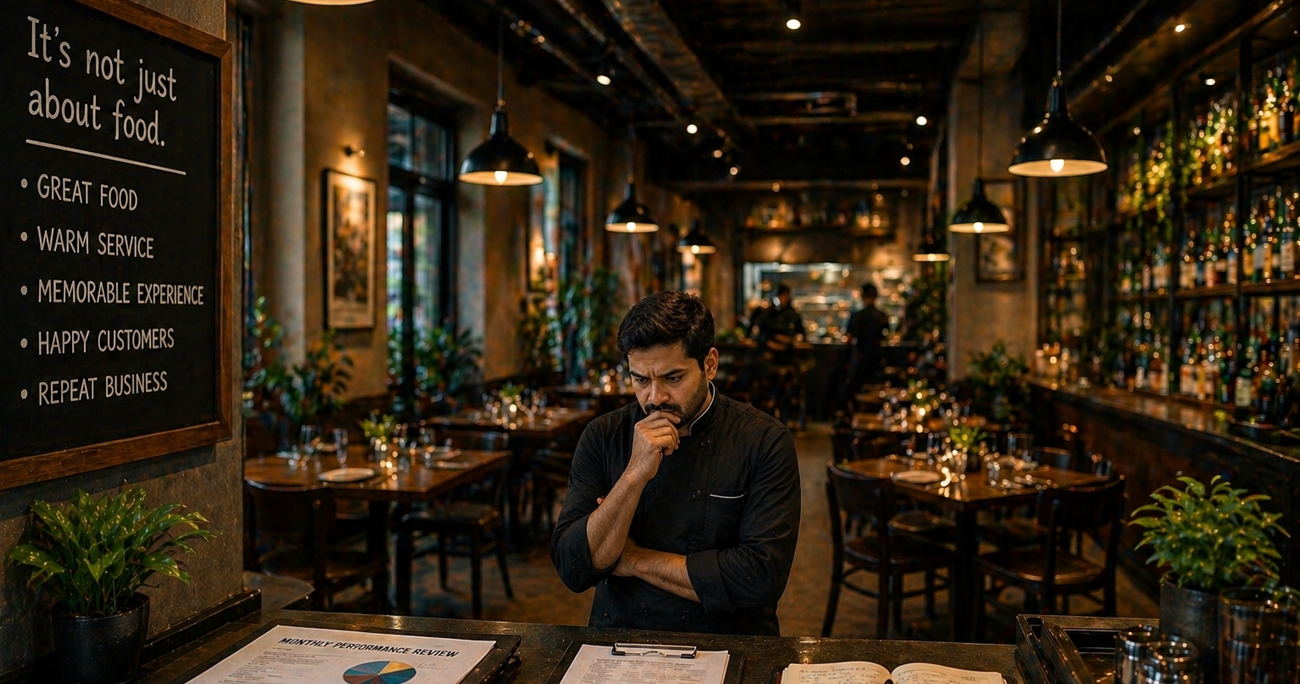
For a long time, the general belief was simple: Do nothing but serve great food, and customers will come back. It sounds logical. After all, restaurants exist to serve food, right?. If the food is good, Nothing else really matters. But today, that logic no longer holds. Yes, serving good food comes above everything, but that alone cannot ensure you profit as an owner or manager. Today, across cities, you’ll find restaurants serving genuinely good food, yet struggling to retain customers or generate profit. At the same time, you must’ve seen a lot of places where the food is decent, sometimes even average, but the restaurant remains busy consistently. It goes without saying that this shift points to a deeper reality: For restaurant owners and managers, food is not as distinctive as it once was. It has now become a standard.
The Modern Dining Equation
Over the years, Customer expectations have evolved significantly. With global exposure, social media, and increased competition, People can choose from a variety of cuisines across regions. This was once considered impressive, but is now expected. These days, when customers enter a restaurant, irrespective of the type of restaurant or the location, they assume that the food will be good. No, they don’t just hope there lies the difference. If the food is bad, it stands out immediately for sure. If the food is good, it simply meets their expectations. What we are trying to convey here is that serving just good food no longer ensures customer loyalty. It for sure prevents disappointment. Those customers are not coming back to the same restaurant just because of the delicious food. Serving good food and preventing disappointment alone can no longer create a memorable customer experience.
Service Shapes Perception
Food is unarguably seen as the foundation of restaurant experience across regions. And Customer service, especially recently, has become an important factor that defines that experience. Customers remember how they were treated just as much as what they ate from a restaurant, sometimes even more. Simply put, service has become more important than ever. Customers do notice how quickly they are greeted and attended to. How polite and professional were the employees? How smooth was the service? And finally, how good was the overall customer service there? A single negative interaction can damage the impact a good meal carries. Similarly, a good, genuine service can improve an average food experience. The customers see it in this way as food satisfies their hunger, but service shapes their opinion of the restaurant.
The Experience Layer
Dining is much more than just a functional activity. Because people don’t go to a restaurant just to eat the see the restaurant as a space to relax, connect, celebrate, or even to reboot after a bad day at work. The ambience of the restaurant plays a crucial role in this. Everything from Lighting, music, and seating comfort all impact the customer experience. And nobody goes to a roadside fast food expecting seating comfort and lighting. That is a different side of the very topic. Okay, coming back to the topic, no doubt a well-designed dining space creates comfort and ease for customers. While a poorly designed one ruins the experience. It does not matter if the food was excellent. No ambience doesn’t replace food here, but it for sure defines how the food is experienced by customers. Those who don’t take the ambience part seriously might need to buckle up, as things have changed.
Consistency Builds Trust
A restaurant can impress a customer once, but that does not guarantee they will return. What drives repeat visits is consistency. Being consistent is highly important for a restaurant to thrive. Customers want to know that the food will taste the same every time they visit. They expect restaurants to deliver the same service standards. And their experience meets or even exceeds their expectations. A disappointing visit right after a great visit can easily break their trust. Once that trust is broken, it’s almost impossible to rebuild. be aware that occasional excellence can never replace consistency.
Convenience Drives Decisions
Customers these days consider factors like location, waiting time, ease of reservations (for premium restaurants), and overall accessibility before making their choice. It is vital to understand that if a restaurant is inconsistent with these, it fails even if the food is good. Customers are choosing restaurants not just based on the quality of food; they are choosing based on how comforting the experience is. And the genuine effort to improve the experience ensures convenience. This convenience definitely results in repeated visits.
Perception Before Reality
A modern-day customer is more likely to form an opinion even before the food arrives at the table. They have already observed the entrance, cleanliness and staff behaviour the moment they enter. They can even check for reviews or photos before even visiting. All these factors contribute to perception. It is this perception that decides the final food experience. A customer who liked a dish on his first visit can rate the same food badly if he had a poor experience in the next visit. Simply because the context in which the food was served has changed.
Value Is More Than Price
These days, customers do not just evaluate price; they evaluate the value as well. Value is the bridge between what they pay and what they experience at a restaurant. Customers may find it ok to even pay extra if they are happy with the overall experience. Similarly, if their experience falls short, even a cheap meal feels expensive, and the customer regrets the visit, decides not to visit the same place again. because for customers, value is nothing but the combination of a restaurant’s quality of food, service, ambience and consistency.
The Shift to Experience-Driven Dining
The restaurant Industry is slowly experiencing a shift from a mere food business to an experience-driven business. The focus given to customer experience is on the rise, no doubt. Which also means People remember how a place made them feel as equally as what they ate from the same place. The restaurant has also become a space to share their experiences, connect with people and have long, meaningful conversations. With social media and travel becoming ever so popular, people are now more and more familiar with global standards, and this has set the bar of customer experience high.
Final Bite
Make no mistake, to serve great food is more or less the foundation of a restaurant, but it is no longer enough to build success on its own. In today’s world, Customers somewhat demand quality. They no longer see it as a reward. What they remember of a restaurant is what actually brings them back to the same restaurant. And it is not just the food. It is also everything surrounding the food. the service, the atmosphere, the consistency, and the ease of the experience. Because in the end, people don’t return for only for the food, they return for how the entire experience in the restaurant made them feel. And that feeling is shaped by far more than what’s on the plate.